Qualcomm Takes Aim at Nvidia With New AI Data Centre Chips
Qualcomm shares surged to their highest level in over a year after the company announced a major expansion into artificial intelligence (AI) computing, unveiling its new AI200 chip lineup designed for data centres. The move marks Qualcomm’s boldest step yet beyond smartphones, as it seeks to compete with Nvidia, the dominant force in AI hardware, and capture a share of one of the fastest-growing markets in technology.
The AI200 series is scheduled to begin shipping next year, with the first major customer being Saudi Arabia’s AI start-up, Humain. The company plans to deploy computing systems totalling 200 megawatts based on Qualcomm’s new chips starting in 2026. This initial deal signals what analysts have described as “early traction” for Qualcomm’s AI accelerator products.

Broadcom vs Nvidia vs Semiconductor Industry
The San Diego-based company’s shares jumped 11% to USD 187.68 following the announcement, their largest single-day rise since April and the highest level since mid-2024. The stock had already gained around 10% in 2025, though it still lagged behind the 40% surge in the Philadelphia Semiconductor Index.
Qualcomm’s expansion into AI represents a strategic diversification under Chief Executive Officer Cristiano Amon. After years of relying heavily on smartphone processors, the company has been gradually building exposure to automotive and personal-computer chips. Now, with the AI200 range, Qualcomm is positioning itself in the data-centre segment, currently the single largest growth area in global semiconductors.
Unlike Nvidia, whose GPUs dominate the AI training market, Qualcomm is focusing on inference, the process of running trained AI models efficiently. Its chips feature a neural processing unit (NPU) originally developed for smartphones, optimised for energy efficiency without sacrificing speed. Each AI200 chip can hold up to 768 gigabytes of low-power dynamic random-access memory (LPDDR), giving it impressive data-handling capability while maintaining lower power requirements, an appealing feature for large-scale data-centre operators.
The company will offer the AI200 in multiple formats: as standalone chips, add-on cards for existing servers, or complete rack-mounted systems. A follow-up generation, the AI250, is already planned for 2027. This flexible product structure allows Qualcomm to target both cloud giants and smaller infrastructure providers seeking more cost-efficient AI processing solutions.
Qualcomm’s management has noted ongoing discussions with major buyers, including Microsoft, Amazon, and Meta, about deploying its server systems. Securing orders from these hyperscalers could materially boost revenue and help offset potential headwinds, such as Apple’s shift toward in-house modem chips. AI growth also offers an important hedge against slowing global smartphone demand, which has constrained Qualcomm’s traditional earnings streams.
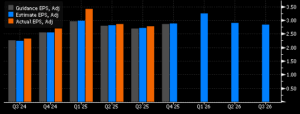
Quarterly Earnings per Share (Note: Actual consistently beating estimates)
While Qualcomm’s entry into AI accelerators comes later than rivals, its advantage lies in power-efficient architecture and memory innovation, traits derived from years of mobile chip expertise. Even small market-share gains in the USD 500 billion-plus AI accelerator industry could translate into billions in additional annual revenue.
In summary, Qualcomm’s AI200 launch positions the company to participate in the next major phase of computing evolution. Though Nvidia remains the dominant player, Qualcomm’s diversification strategy and technological efficiency may enable it to carve out a meaningful niche in the years ahead, providing long-term support for portfolio investors seeking exposure to AI-driven growth.