Global equities dropped on Wednesday after credit rating agency Fitch downgraded the US credit rating, while a stronger-than-expected private ADP employment report added to caution ahead of Friday’s non-farm payrolls.
United States
August has historically been the seasonal underperforming month, a time when many Americans go on annual leave before the beginning of the new school year. In what was widely already known as a possibility, having been flagged during the debt ceiling negotiations earlier this year, Fitch downgraded the US’ status from AA+ to -a, noting recent political controversary as concerning as well as the nation’s debt trajectory, forecasting debt to reach 118% of GDP by 2025 The decisive prompted memories of the 2011 downgrade, which lead to short-term volatility, but was ultimately brushed off by investors. The downgrade by Fitch is meaningful and should not be ignored, however, concerns of its impact may be overstated with several US officials voicing their confusion over the decision, as well as noting that the USD and Treasuries remain the preeminent safe haven for global investors.
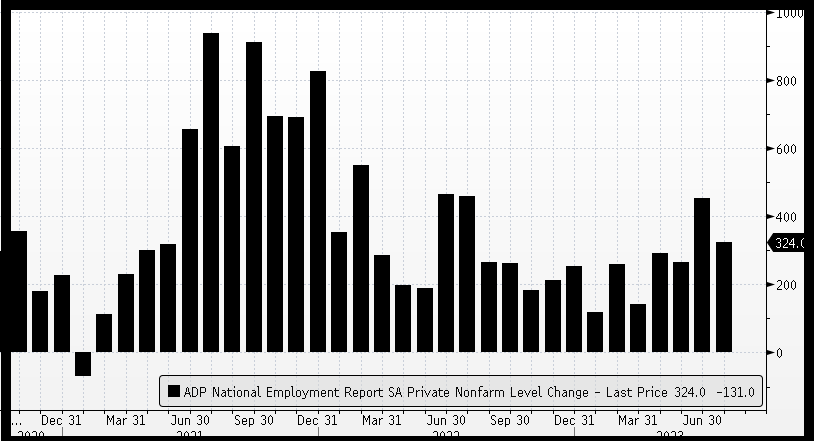
In economic data, the ADP national employment report showed that US private payrolls rose by 324k in July compared to the 455k rise in June, and nearly double the forecast of 189k. The data reveals a moderation in wage growth, which bodes well for the inflation outlook. As investors turn their attention to the upcoming July non-farm payroll data, they should note that there is a very weak correlation between the ADP figures and non-farm payrolls rate. Non-farm payrolls are forecast to remain relatively flat at 200k for July compared to 209k in June, with the unemployment rate expected to remain stable at 3.6%. Also in focus tonight are earnings releases from both Apple and Amazon.com after the US close on Thursday. as well as corporate earnings from Apple and Amazon, set to be released on Friday.
US ADP Employment (MoM 000’s)
The S&P 500 declined by -1.38% on Wednesday, with 73% of the index closing in the red. Technology, communications and consumer discretionary were the biggest laggards, dropping -2.59%, -2.07% and -1.84% respectively. Consumer staples and healthcare were the only sectors to close higher, edging up by 0.25% and 0.06% respectively. The Dow Jones fell -0.98%, the Nasdaq Composite slumped -2.17% while the Russell 2000 Index declined -1.38%. As one would expect, large declines in equities saw a sharp spike in the VIX of 15.51% to 16.09.
In the bond market, the yield curve steepened as investors sought safe-haven in short-term Treasuries, with the yield on the 2-year -2.4 basis points lower at 4.88% while the 10 and 30-year yields gained 5 and 8 basis points respectively. Over the past 23 years, an uninventing yield curve has been a bearish development, with the Fed having to aggressively cut rates in reaction to crisis’ which developed following tightening cycles. However, it is too soon to suggest an un-inversion in the current environment would be bearish, given the quick nature of Fed officials to backstop liquidity in the banking crisis in March while being able to tighten rates. Additionally, steepening yield curves in the 70s and 80s were ultimately bullish for equities reacting to policy normalisation following the taming of inflation, not unlike the current environment.
Europe
In Europe, the STOXX 600 Index fell by -1.30% at the end of trading on Wednesday, amid broad-based selling. Utilities was the biggest underperformer declining by -2.04%. The CAC lost -1.26%, while the DAX and FTSE receded -1.36% each. The BoE is expected to announce a twenty-five percentage points hike in the interest rate later today, from 5.0% to 5.25% later today.
*Note: These prices are based on futures and/or CFD pricing and may therefore differ slightly from spot pricing.
Australia
The ASX is expected to open lower on Thursday, with ASX futures down by -0.79% to 7,241. The Index fell by -1.29% at the end of trading on Wednesday with sentiment weighed by the US credit downgrade decision with selling broad-based as all sectors closed lower along with 87% of stocks. Stock prices for the big banks dropped including ANZ (-2.05%), CBA (-2.26%) and WBC (-2.01%). In materials, BHP lost -1.12%, RIO slid -0.90%, while Pilbara Minerals gained 0.41% and South32 firmed 0.51%. In energy, Paladin rallied 1.30%, New Hope advanced 0.37%, meanwhile Whitehaven, Woodside, Beach Energy and Santos receded between -0.72% to -1.62%. In individual stocks, Pro Medicus was the star performer jumping 2.98% while Centuria Capital was the biggest underperformer, sinking -5.34%. The Australian dollar, which is seen as a risk-on currency, slumped -1.13% on Wednesday to 0.6538 while bond yields were little changed.
Commodities
In commodities, the price of oil dropped with the WTI and Brent Crude declining by -2.31% and -1.87% to $79.49 and $83.32 respectively. Precious metal prices continued to fall, with spot gold sliding -0.51% to $1,934 while spot silver dropped -2.42% to $23.71. Industrial metal prices sank, with copper losing -1.66% to $384.35 and SGX Iron Ore fell -2.01% to $103.90. Meanwhile the price of bitcoin declined by -0.4% to $29,107.
Economic Calendar
3rd August 2023
Australian Services PMI (MoM Jul) 09:00
Australian Retail Sales (QoQ Q2) 11:30
China PMI (MoM Jul) 11:45
BoE Interest Rate decision 21:00
US Composite PMI (MoM) 23:45
This article was written by James Woods, Portfolio Manager, Rivkin Securities Pty Ltd. Enquiries can be made via [email protected] or by phoning +612 8302 3632.

